
Pedigree Certificate
Search for a glider by name, breeder or ID to make its Pedigree Certificate, with four generations, ready to save or print.
The import lines, listed
Wild caught, listed
The families, listed
Find a family
They are not all the same kind of thing, so they are sorted by what is actually on the records.
Type a breeder, an owner or a glider's name, or open one of the groups below. Each group says what kind of families are in it.
Understanding COI
The coefficient of inbreeding, or COI, estimates how much of a joey's genome would trace back to the same ancestor through both parents at once. The closer that shared ancestor sits on both sides, the higher the number, and the greater the chance that two copies of the same hidden genetic problem end up paired together. Low numbers are good: Sugentra considers 5% or below a good pairing, and risk rises as the percentage climbs. Sugentra computes COI with Wright's Path Coefficient (1922), the standard method for pedigrees, through Compatibility Check and Test Joey. Both report the result in this guide's own color bands, so the number you get always maps back to the chart below.
Let the number lead, not the label. A relationship name like "2nd Cousin" is convenient shorthand, but it is not the deciding factor. Two pairs with the same named relationship can land on different COIs when more than one shared ancestor is in the mix, or when one connection is a full sibling line and the other a half sibling line. Always check the calculated COI for the specific pair and weigh the relationship as context around it. There is no universal safe number either: most breeders set their own standard, use COI as the first filter, and then confirm the relationship makes sense on top of it.
Standard degree-of-relationship table: each cell is the expected COI for that named relationship, based on how many generations back the shared ancestor is on each side. A pair that shares more than one line adds each one together, which is what Compatibility Check and Test Joey do automatically for a real pairing. "Gr." is short for "Great" and "x Removed" means the two sides sit that many generations apart in the same cousin line (e.g. a 1st Cousin 2x Removed shares a great-grandparent with one side, but only a great-great-great-grandparent with the other). The small underlined number in each cell is just the combined generation-distance to the shared ancestor (i + j), a quick way to cross-check your count, not the COI itself.
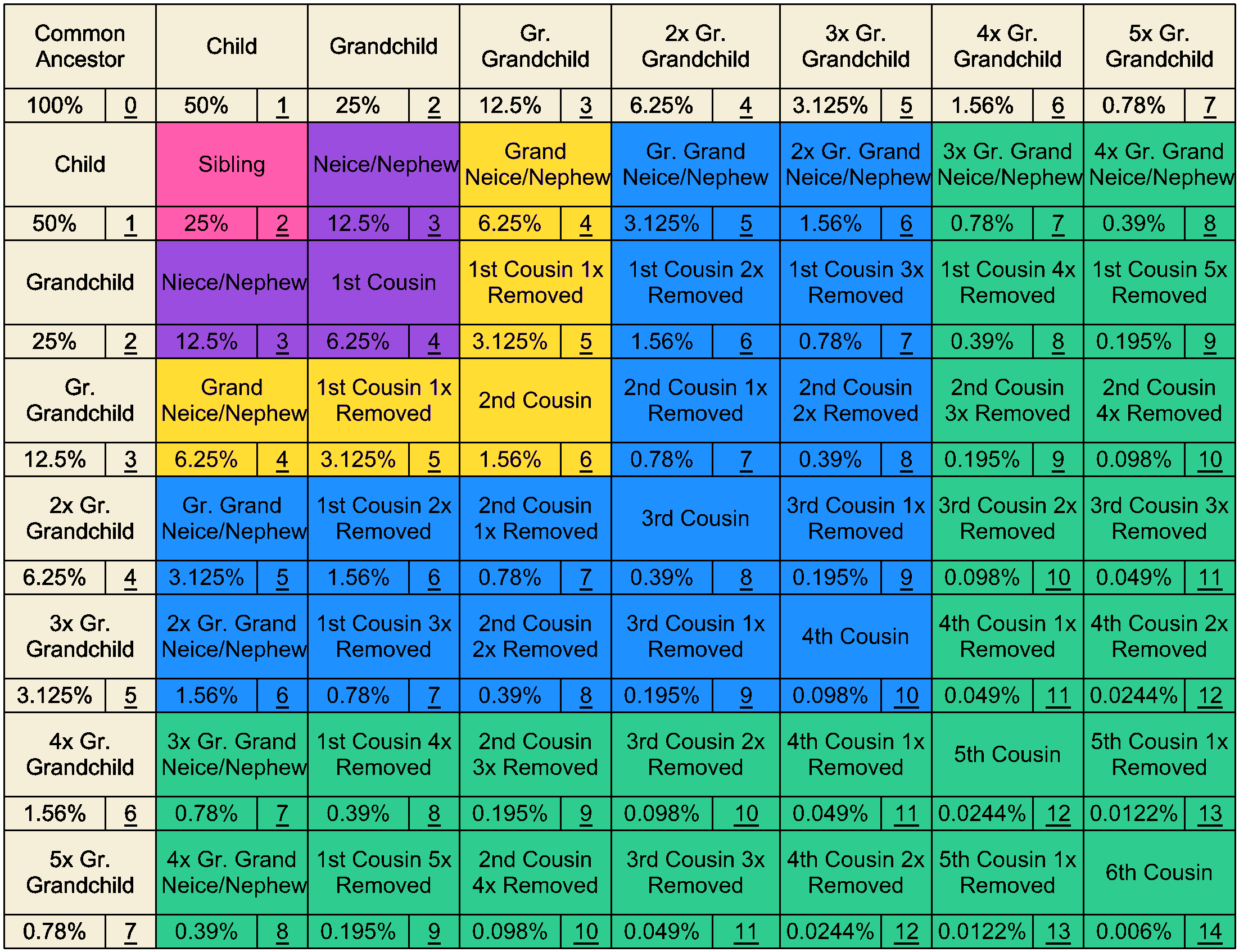
| Color | Meaning |
|---|---|
| Inbreeding: These pairings are very closely related and should be avoided. They have the highest likelihood of genetic defects and issues. | |
| Close Line Breeding: These pairings should only be done limitedly when necessary to achieve, perfect, and maintain certain characteristics by responsible and experienced breeders. | |
| Line Breeding: Pairings can be done limitedly to achieve, perfect, and maintain certain characteristics by responsible and experienced breeders. | |
| Distant Line Breeding: At this point, some breeders may classify the gliders as unrelated and safely pair them with limited possibilities of potential genetic problems. | |
| "Unrelated": Enough genetic difference to avoid most problems related to inbreeding or line breeding. |
Neither COI nor the relationship label is enough on its own, use them together:
Two real examples of why the combination matters more than either number alone:
Happy OOP Date
Every glider with a usable OOP date, checked against today. Not every record carries a full date, so this can only ever be as complete as what's on file.


About Sugentra
Sugentra is a pedigree and lineage platform for the sugar glider community. I built it because I kept needing it and it kept not existing.
The records were always out there, but getting a straight answer out of them took hours. Now it takes seconds, and it's free, because charging people to look up their own animals felt gross. It brings the community's records together and turns them into something you can see, check and use, because good breeding decisions start with knowing where a glider comes from.
Modern and Classic
- Sugentra comes in two views. Modern is the full site, with its 3D pictures, moving visuals and sounds. Classic is a plain version with the same colours, logos and buttons, the main pages as big buttons across the top, and nothing moving.
- The square in the top corner switches between them at any time, Classic View in Modern and Modern View in Classic, and your choice is remembered for next time.
See the whole family
- Every glider on record drawn as one living tree, so you can see how lines connect instead of clicking through them one parent at a time.
- The gliders alive now are the canopy and the oldest founding lines are the roots. The more descendants a glider left, the bigger it glows.
- Click any glider and four generations of its family open up, colour coded, and every name in the box opens that glider.
- Focus Glider finds your glider in the tree, zooms in on it, and opens its own family web. Full Network brings the whole tree back.
- One breeder's gliders on their own, so a breeding program can be understood at a glance. Red is bred and still kept, yellow is bred and placed with someone else, blue is kept but bred by somebody else, green is bred with no owner recorded, purple is kept with no breeder recorded, and the lines join gliders that are family.
- Search a breeder to see every glider they bred and owned.
- A full breeding report underneath: how long they've been going, how complete their records are, the colours they produce, which pairs they breed, how closely related their pairings are, where the gliders they bred live now, and how the program reads over the years.
- New: save the whole report as a ZIP, one PDF for each section.
- A glider's whole line traced as far back as the records go, because a problem in a line can sit many generations back.
- Each generation has its own colour, always in the same order, so you can read how deep a line goes at a glance.
- New: drawn in lineage boxes, like the lineage on a profile: the glider at the top, its parents under it, and each generation before them going down. Blue outlines are males and pink outlines are females.
- Tap a box to open that glider. Every generation on record is shown at once, as far back as the record goes.
- Every ancestor is listed underneath, generation by generation, with how each one is related to the glider.
- The founding gliders almost every glider alive today comes from, listed by breeder.
- The founders almost every glider alive today comes from, drawn as a galaxy, so you can see how few lines the whole population rests on. The brighter the star, the more gliders trace back to it.
- Every import mapped by the country it came from, because imports are where family trees begin.
- A list of every import under who brought it in, with its colour, country, arrival date and descendants. Where nobody recorded the importer, the likely one is marked as likely, so a guess is never passed off as a record.
- Every glider with an import in its ancestry wears a small globe. Press it to see which imports, on which side of the family, and how many generations back.
- An import is shown as a founder, not given a made-up parent.
- Families whose trees never join the rest. Nothing on file ties them to the main records, so their ancestry can't be checked against them.
- Shown in the roots of a seedling, with a searchable list of every family underneath.
- Every one of those families is listed, and the list can be searched.
- New: every glider on record that was caught in the wild.
- Shown as sugar glider paw prints with the wild caught circling them like satellites, coloured by the country each came from, with a list of every one by country underneath.
- Any glider bred from a wild caught one wears the 🐾 paw on its profile. Tap it to see which wild caught gliders are in the ancestry and how far back.
- Registering a wild caught glider? Tick This glider is wild caught. It is marked as an import for you as well.
Breed with better information
- How closely related a pair is, and the ancestors they share, because pairing close relatives raises the risk of health problems in the joeys.
- The two signs crash together and spin while the numbers are worked out, then come apart showing the percentage before the full report opens.
- Three COI figures: the original published figure, Sugentra's figure counted eight generations back, and one counting every generation on record.
- New: Where the COI comes from lists the ancestors that make up the figure and each one's share, so you know exactly which line to watch.
- New: Ancestor loss shows how much a line folds back on itself.
- Plan ahead one generation. Pick a father and a mother for Joey A and a father and a mother for Joey B: two joeys from pairings that haven't happened yet.
- It works out how related the babies would be if Joey A and Joey B were later paired together, so you can tell before either litter is born whether keeping a joey from each pairing would be a good match.
- No throwaway record goes into the database: the two joeys exist only for the check.
- Test joeys that were registered as real gliders in the past are flagged across the site: the name is highlighted in purple with an orange ! beside it. Tapping it asks whoever owns the record to delete it, since this tab does the job now and a fake joey muddies the real pedigrees.
- The four signs, two fathers and two mothers, crash together while it works, then show the percentage before the report opens.
- The report gives Sugentra's two figures, the ancestors the joeys would share, where the COI comes from, and ancestor loss.
- Test Joey and Color Produced in one. Pick the parents for Joey A and for Joey B, two joeys from pairings that have not happened yet.
- It shows what colours each joey could be, what colours the two of them would produce together if they were later paired, and the COI of that pairing.
- Only the four parents' own records count, as in Color Produced. No record is made.
- The colours a pairing can produce and how many in a hundred would show each, counted from real joeys on record, because many morphs have no simple rule that predicts them.
- New: worked out the way the genes really pass on, following the confirmed genetics: Platinum and Leucistic as one gene, Albino and Creamino as two, and Carmino told apart from Caramel Albino using each glider's notes.
- New: Lion, Ringtail, Red, White Tip and Paradox get no odds, since no rule predicts them. Caramel (Merauke) comes with its warning that joeys can be sterile, and every result reminds you that hets can still show.
- The hets each line carries are listed, and every colour has its own glider picture.
Math you can rely on
- Wright's method: inbreeding figures use Wright's method, the standard for pedigree work.
- Contradictory records set aside: two gliders each listed as the other's parent can't both be true, and counting them would make a figure wrong.
- Test joeys and stand-ins left out: they aren't real gliders and would throw off the counts, including ones typed with a typo or joined into one word.
- Eight generations: the usual depth for pedigree work.
- Every generation on record: lines bred closely for many years can share ancestors further back than eight generations, and the first figure would miss them.
Find any glider
- Type a name, breeder or id and press Go to see every match. Pick one to open its profile.
- A magnifying glass made of every glider on the site, one particle each. Type a name, breeder or id and press Go: the matches light up, and picking one zooms into its particle and opens its profile.
- Reverse Search works backwards, showing a glider's joeys or everything a breeder produced, and its results light up in the glass too.
- Opening Search from the menu starts fresh; Back still returns you to the glider you were on.
Profiles
- Everything on record: owner, breeder, parents, colour, genetics, birth date, partners, joeys and siblings.
- Parents never recorded show as Unknown; parents two records disagree on show as Contradictory.
- New: ancestor loss on every profile.
- New: health notes, kept by the glider's owner and private unless the owner makes them public. Public notes carry down to every joey, so a problem in a line can be seen before a pairing is made.
- A history of what each record used to say, so you can read a lineage as it is now and as it was.
- New: marks taken from the glider's own record: 💀 when it has passed away, 🏠 when it is pet only, and retired when it no longer breeds. Its owner can tick or untick each one in Edit profile.
- New: ticking deceased in Edit profile also lets the owner add the date it passed away. It is never required, and it shows on the Rainbow Bridge.
- New: an out of pouch date with only a month and a year is fine, since often nobody knew the day, and a month typed as a word shows as a number, so Oct 2015 reads 10/2015.
- A breeder known by two names has one page, showing both.
Records you can verify
- Claims reviewed by hand: every claim to a lineage is checked before it links to an account, so nobody can claim a line that isn't theirs.
- Documented imports: an import with its paperwork wears a mark saying it was checked, not just claimed, because its origin is the start of every line that comes from it.
- Records checked against each other: problems like a father recorded as female or a joey dated before its mother are found and shown to the owner to fix.
- Colours reviewed: new colours are added only after review, so the colour list stays accurate.
Make it yours
Add your own gliders. Each gets its own Sugentra id and works in every tool on the site, the same as any other record. New: a glider you register is yours. It shows on your Account page under Lineages you registered, and you can suggest changes to it there, with no lineage claim needed. Every change shows on the site as soon as you save it. Only the site admin can delete a glider.
The basics
- Name, sex, out of pouch date, a photo, genetics and remarks.
- Colour picked from the list. If yours isn't there, request it from the same box and it comes to me for review.
- New: country. Type the country the glider was bred in and pick it from the list (UK, USA and England work too, and find the United Kingdom and United States). A small flag then shows beside its name everywhere on the site, and on its profile. It's optional, and Edit profile on the glider's profile can change it later.
Parents
- Search the father and mother by name, or leave either blank if unknown.
- New: trios. If the father lives with two females and you can't tell which one had the joey, name the other as the second mother. It's optional, and it never changes pairings or COI, which always use the first mother.
Imports
- Tick the import box for a glider brought in from another country. It's filed as a founder with no parents instead of a made-up one.
- Record who brought it in, the country it came from and its arrival date.
- Add a photo of its paperwork, and it wears a documented mark saying it was checked, not just claimed.
Status
- Curly: marks a curly glider.
- Pet only: marks a glider that isn't a breeder.
- Retired: marks a glider that no longer breeds.
Health
- New: health notes, one per line, with examples in the box of what to write.
- Private unless you tick Show publicly. Public notes also show on every joey out of that glider.
Checked before it's saved
- A father recorded as female or a mother recorded as male is caught.
- The same glider can't be both parents.
- A date that can't be read or is in the future is caught.
- A timeline that can't happen, like a joey out of pouch before its parents, is caught.
- New: a framed certificate in the shape of a landscape sheet of paper, with a DNA helix border, glider art beside the title, the glider's photo, and four generations in the right places, to hand to a new owner with their joey.
- Your own accent colour and background colour, both changing live as you pick, your own font, and your logo or the helix emblem.
- Save downloads a sharp picture; Print fits it on one landscape page.
- You need to be signed in to make, save or print one.
- Bold pink and blue sex signs, long names shrink to fit, and unknown or contradictory ancestors are left blank rather than filled with a wrong name.
- New: a profile that feels like yours: banner, picture, business name, a link, a song, background, about section, photo portfolio and social links.
- New: stickers you can place and resize, by dragging a corner or pinching on a phone.
- New: Your lineages lists every name you've claimed, with how many gliders each has bred and owns. Only you can see it.
- Shuggie, a cozy care app with a virtual sugar glider of your own that grows as you care for your real ones.
- Daily care to check off: fresh water, a clean enclosure, feeding, pouch time for bonding, nail trims and nightly check-ins.
- Every task done fills your glider's glide bar. A full bar sends it off to explore places inspired by the real world, from Australian gum forests and Indonesian rainforests to Thai hilltops and American redwoods, each with treasures to find.
- Make it yours: dress it in real sugar glider colour morphs, decorate its enclosure with toys and hideaways, and bond with it one treat at a time.
- Join the Colony with friends, take on daily, weekly and monthly quests, and unlock trophies along the way.
- Open it from the Care Companion button, then tap the turning logo.
- Your gliders, customers, adoptions, finances, weights and vet logs, kept together in one place, with medicine reminders.
- A weight report and a full backup of your records, saved as a PDF.
- Glider Tracking is inside it.
- SuggieHub, an online home for sugar glider owners, whether this is your first glider or you've kept them for years.
- A profile for each of your gliders, with their weights, health, medication, milestones and important dates recorded in one place.
- Help and information for understanding and caring for your gliders, and a community of people who keep them.
- Open it from the Glider Tracking button, then tap the turning logo to go to suggiehub.com.
Info
- COI Guide: what the inbreeding number means, a chart of where a pairing lands, and a key to every colour.
- Database Stats: everything on record, plus two new sections. Most used sires and dams shows what share of today's gliders descend from each, because a few gliders used heavily shrink the gene pool. Founders over time shows how many founders make up half of each year's gliders, because a falling number is the early sign of lost diversity.
- Happy OOP Date: gliders turning a year older on the day they came out of pouch, each with its own card, confetti and a birthday chime.
- Rainbow Bridge: in loving memory of the gliders that have passed, with each one's years and a few kind words. Search one and its cloud climbs the rainbow to the door.Search one to see its memorial.
- Privacy: New: what Sugentra keeps, who can see it, and how to have it changed or removed.
- Tutorial: a guided tour where you actually push the buttons, and it remembers where you stopped.
- Contact: straight to me, no account needed, or email [email protected].
Know the lineage, breed with ethics, love your gliders.
The pedigree records are mirrored from The Pet Glider's public database. That part is theirs, and their database stays the source of truth for it. New gliders are picked up from it all day, and every record is read again each week, so Sugentra stays up to date. Sugentra is its own independent thing, not affiliated with them or run by them.
The records are the only thing here that came from somewhere else. The ancestry network, the breeder web, the generation pyramid, Founding Stars, the compatibility and test joey tools, the COI engine, the colour work, the certificates, the way the whole thing looks and every word on it are mine, built from nothing. Mirroring a database is not the same as building what you do with it.
Real talk on the data: breeders and owners typed all of this in over a couple of decades, and Sugentra is where it gets looked after now. Records that don't add up get flagged, owners can fix their own lineages, and a correction made here stays. Every figure is worked out from what's on file, and when a record changes, Sugentra remembers what it used to say, so you can read a lineage as it is now and as it was then.
Contact
Questions about a record, a colour that is missing, a claim on your lineage, or anything that looks wrong: send it here. It goes straight to the site admin, inside Sugentra. You do not need an account to write.
Or email [email protected]
Privacy
What Sugentra keeps, why it keeps it, who can see it, how long it stays, and how to have it changed or removed. Updated September 28, 2026.
In short
- No ads, and nothing about you is ever sold, rented or traded.
- Your email address is never shown to other members or visitors. Only the site admin can see it.
- Sugentra emails you twice at most: a link to confirm your email when you sign up, and a password reset link when you ask for one.
- Your password is kept scrambled, so nobody can read it, not even the site admin.
- Health notes are private unless you choose to share them.
- Photos you upload have their hidden location and camera details removed before they are saved.
- You can change your profile at any time, and ask for anything on your profile or account to be removed. Glider records stay.
The glider records
Sugentra's pedigree records began with The Pet Glider's Pedigree Program, a free public database built so anyone can trace a glider's lineage. On Sugentra those records are kept, corrected and added to. A record shows what it always has: the glider's name, colour, genetics, out of pouch date, parents and remarks, and the names of its breeder and owner as they were entered. These records are public, the same as they have always been.
When a record changes, Sugentra keeps what it used to say, so a lineage can be read as it is now and as it was. That history is part of the record.
A glider registered directly on Sugentra is public in the same way, with everything that was entered when it was registered.
Because these records are public, anyone can read them and draw their own conclusions. Sugentra is not responsible for what anyone says, thinks or does because of what the records show, on or off the site. See the Terms of Use & Disclaimers at the bottom of every page.
Your account
To make an account Sugentra asks for three things:
- Your email address, to sign you in, to confirm the address is yours, and to send you a link if you forget your password. It is never shown to other members or visitors. The site admin can see it, to know who has joined and to look after accounts.
- A display name, which is shown on your profile.
- A password, which is scrambled the moment you set it and never kept as you typed it. It cannot be turned back into the password, so nobody can read it.
A new account confirms its email address with the link sent to it. Until the link is pressed, the account works the way the site does for a visitor with no account: you can search, browse and read every lineage, and nothing else. Nobody has to approve an account.
When you sign in, your browser is given a random sign in key, so the site knows it is you from page to page. Signing out ends it. If you tick to stay signed in, your browser keeps that key until you sign out. Resetting your password signs you out everywhere.
To stop anyone guessing passwords, a few wrong tries in a row on one account pause signing in to that account for a short while.
Your profile
What you put on your own profile is public: your display name, photo, banner, business name, bio, links, song, portfolio, stickers, and the lineages you have claimed. A photo you add to one of your gliders is public on that glider's page. You can change or remove any of it at any time from your Account page.
Photos taken on a phone usually carry hidden details: where the photo was taken, the phone that took it, and when. Sugentra removes those details from every photo before it is saved, so a picture on your profile shows only the picture.
If you add a song, it plays from the service it comes from, YouTube or SoundCloud, inside your profile. Those players are run by those services under their own privacy rules. YouTube songs use its privacy enhanced player, which does not set tracking cookies unless the song is played.
Claiming a lineage
When you ask to claim a breeder name, your display name, the name you are claiming and any business name you give are sent to the site admin to review. Once a claim is approved, that breeder's page on Sugentra becomes your profile, and you can correct the records of the gliders you own. A change you make to your own glider shows on the site as soon as you save it.
Health notes
Health notes you add to your gliders are private. Only you can see them, and nobody else, not even the site admin. If you choose to make them public, anyone viewing the glider can read them. You can make them private again, or delete them, at any time.
Messages and requests
When you write through the Contact page, your name, the email address you give and your message go to the site admin, and are used only to reply to you.
Colour requests, lineage claims and fix requests are kept, with who sent them, so the admin can review them and so there is a record of what was decided.
Emails from Sugentra
Sugentra emails you only about your own account: a link to confirm your email address when you sign up, which works for three days, and a link to reset your password when you ask for one, which works once and stops working after an hour. There are no newsletters, and your address is never added to any mailing list. The site admin receives a notice by email when somebody signs up or a message or request comes in.
Emails are sent from [email protected] through an email delivery service, Resend. To deliver an email to you it is given your email address and the email itself, and nothing else about you. It does not track whether you open an email or press a link in it. A reply to a Sugentra email goes to the site admin at [email protected].
How the site is kept and delivered
Sugentra runs on a rented server in a secure data centre. The records, accounts and uploaded photos are kept there. Copies are made regularly, so nothing is lost if something goes wrong, and a copy is also kept offline by the site owner.
Every visit passes through a security and delivery network that keeps the connection encrypted, which is the padlock in your browser, and stops attacks before they reach the site. To do that it handles each visit's connection details, such as the internet address it comes from and the page asked for, the same way any network that carries a website does.
Sugentra is not open to visits from some countries. That network tells the site which country a visit comes from, and a visit from a closed country is turned away. The site keeps a count, by country and by day, of visits, sign ups and visits turned away, and a count of visits by state or region (such as California or Ontario), never by city. They are counts only: no internet address is kept with them, and nothing that says who a visitor was.
Keeping it safe
- Every page and every request travels over an encrypted connection.
- Passwords are scrambled with a random value unique to each account.
- Repeated wrong passwords, and too many requests at once, are slowed down or stopped.
- The site will not run scripts from anywhere else, which blocks a common kind of attack.
- Only you can change your profile, and only a glider's owner can change its record. The site admin cannot change your gliders either.
On your own device
Sugentra sets no cookies. Your browser keeps a few settings for you in its own storage: your sign in if you tick to stay signed in, where you stopped in the tutorial and whether its narration is on, your certificate choices, and whether this browser has visited before. They stay on your device, and clearing your browser's site data removes them.
What Sugentra does not do
- No ads, and no advertising or tracking cookies.
- No selling, renting or sharing of anything about you.
- No emails you did not ask for.
- Your email address is never shown to other members or visitors.
How long things are kept
Your account, profile and health notes stay until you change or remove them, or ask for your account to be deleted. Requests and messages are kept as a record of what was asked and decided. Glider records and their history stay, since other gliders' lineages run through them. When something is deleted it leaves the site at once, and leaves the backup copies as they are replaced over time.
Young members
Sugentra is made for sugar glider breeders and owners. Accounts are for people aged 13 and over.
Changing or removing your information
You can change your profile at any time from your Account page. To delete your account, remove something from your profile you cannot reach, find out what is kept about you, or ask anything about this page, write through the Contact page or email [email protected]. A glider record that is wrong can be fixed right here: press ✏️ on the glider if you have claimed the lineage, or write through the Contact page.
Changes to this page
If what Sugentra keeps or how it uses it changes, this page is updated first, with the new date at the top.
Tutorial
A guided tour of the whole site. It moves through every tab with a spotlight and a short explanation of each one, and the site stays fully usable while it runs, so you can try each thing the moment the tour points at it. Click Next and Back to move through it, and press Escape to leave at any point. There is a speaker button on the tour card if you would rather have it read aloud.
Loading stats…
Register a Sugar Glider
Adds a glider to Sugentra's own records, for an animal with no existing record or a joey you want tracked here. The record lives on Sugentra and nowhere else.
Search / Lookup
Enter a name, pedigree ID, or SH-G ID. The local database is searched first, and missing records are fetched from the source automatically.